|
Other articles:
|
Specific Heat. the ratio of heat capacity of a substance to the heat capacity of water. Another way of looking at it is the quantity of heat required to .
Specific heat capacity: 0.71 J g-1 K-1, Heat of atomization: 456 kJ mol-1. Heat of fusion: 50.21 kJ mol-1, Heat of vaporization: 359 kJ mol-1 .
File Format: PDF/Adobe Acrobat - Quick View
To calculate specific heat of a food material, you need to know its composition. If the composition is unknown, then USDA Handbook 8 may be helpful. .
The Specific Heat Capacity is the amount of heat required to change a unit .


 Specific Heat, a measure of the heat required to raise the temperature of a given amount of a substance by one degree. It is best defined as a ratio, .
You may have measured the specific heat capacity of water in school laboratory by standard equipment like an electric heater and a joule meter. .
File Format: Microsoft Powerpoint - Quick View
Use our free online units converter for specific heat capacity.
Convert between units of specific heat capacity or specific entropy using this on-line calculator.
The specific heat capacity of a solid or liquid is defined as the heat required to raise unit mass of substance by one degree of temperature. . 
 The ratio of the amount of heat required to raise the temperature of a unit mass of a substance by one unit of temperature to the amount of heat required to .
1781 Wilcke comes up with the concept of specific heats. 1819 Objects have a heat capacity, while materials have a specific heat capacity (often just called .
2) specific heat capacity of the substance (a measure of how much energy the substance absorbs to change the temperature 1oC). . 


 Specific Heat Capacity (Cg) of a substance is the amount of heat required to raise the temperature of 1g of the substance by 1oC (or by 1 K). .
Common metals - aluminum, iron, mercury and many more - and their specific heat capacities - imperial and SI units.  The specific heat (also called specific heat capacity) is the amount of heat required to change a unit mass (or unit quantity, such as mole) of a substance . 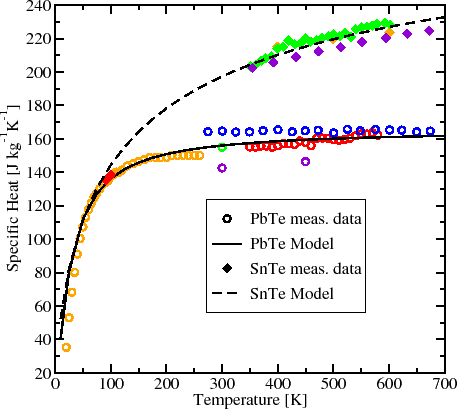 name Marc status educator grade 9-12 location IL Question - Is there a relation between thermal conductivity and specific heat (heat capacity)? .
specific heat ratio of the heat capacity of a substance to the heat capacity of a reference substance, usually water. Heat capacity is the. 
 Specific Heat Capacity (C or S ) - The quantity of heat required to raise the temperature of a substance by one degree Celsius is called the specific heat .
11 Jul 2008 . where delta T is the change of temperature of the gas during the process,and c is the specific heat capacity. We have added a subscript "p" .
Specific heat at constant pressure Materials & Chemical Engineering discussion.
specific heat (physics), ratio of the quantity of heat required to raise the temperature of a body one degree to that required to raise the temperature of .
8 posts - 6 authors - Last post: 15 Feb 2008But in most situations where the solute (HCl) is dilute, the specific heat capacity of the solvent (water) will only be affected to a .
Science Question: What Does Specific Heat Mean? Specific heat is defined as the heat supplied to raise the temperature of one gram of a substance by one .  21 Jul 2008 . The heat energy needed to change the temperature of an object depends on the heat capacity of the object. The specific heat is the heat .
Specific heat, definitions and formula, water equivalent of a body, latent heat of fusion and latent heat of vaporization with solved examples.
A note on Format and Accuracy is available. There are also some Background Notes on Specific Heat Capacity. Go to the, Dictionary of Units, OR the .  File Format: PDF/Adobe Acrobat - Quick View
Specific heat capacity, energy is required to raise the temperature of an object . How much energy depends on the material the object is made of. Q=mc.  6 Jul 2009 . Specific Heat. The ability of water to stabilize temperature depends on its relatively high specific heat. The specific heat of a substance .
specific heat n. The ratio of the amount of heat required to raise the temperature of a unit mass of a substance by one unit of temperature to the.
Screen shot from CHEMIX School Periodic table - Specific Heat Capacity table. When clicking the radio button (3) the specific heat capacity of all the .
The specific heat of pure glycerine falls within the range of 0.575 to 0.5795 . Specific heat data for glycerine-water solutions from 0 to -30°C (32 to .  perform conversions between Specific Heat Capacity units.
Specific Heat Capacity - Science and Engineering Encyclopedia.
4 Mar 2011 . Specific Heat Capacity of technical sugar solutions.  Due to the large specific heat capacity of water, a small change in temperature of water requires a large heat transfer. For the same rate of heat transfer, .
Periodic Table of the Elements Specific Heat Capacity . Graph: Specific Heat Capacity vs. Atomic Number. Graph of data. Atomic Number .
6 Dec 2007 . I am finishing science homework and would like to know how to . Heat a known mass of a metal to a known temperature (say, for example, .
the number of calories needed to raise the temperature of one gram of a given substance 1°C; the ratio of the amount of heat required to raise the .
specific heat - definition of specific heat from BusinessDictionary.com: Amount of heat required to raise the temperature of a unit mass through one degree .
The specific heat capacity of water is known (4.184 J oC-1), and the temperatures TCu, Ti, and Tf can be measured experimentally. The masses of the copper .
The specific heat is the amount of heat per unit mass required to raise the temperature by one degree Celsius. The relationship between heat and temperature .
The specific heat capacities of substances comprising molecules (as distinct from monatomic gases) are not fixed constants and vary somewhat depending on .
Thus, specific heat of a substance may be defined as 'the quantity of heat required to increase the temperature of unit mass of the substance through 1oC'. .  The 'specific heat' (or 'specific heat capacity') of a material is the quantity of (heat) energy needed to raise the temperature of a unit quantity of the .
Specific heat is another physical property of matter. All matter has a temperature associated with it. The temperature of matter is a direct measure of the .
Brief and Straightforward Guide: What Is Specific Heat? 
 Sitemap
|